Introduction: The Universal Burden of Caring
We live in a world that constantly demands our attention, energy, and, most importantly, our care. From global politics and social media trends to family drama, work emergencies, and the endless pursuit of perfection—we’re conditioned to believe that a good person, a responsible employee, or a loving partner must pour their heart into everything.
This habit of indiscriminate caring, however, is not a superpower; it’s a slow leak. It drains our mental reserves, dilutes our focus, and ultimately leaves us exhausted, ineffective, and disconnected from our truest, higher self.
The fundamental truth you must embrace is this: Your capacity to care is a finite resource. Just like money or time, if you spend it freely on every trivial demand, you’ll have nothing left for the investments that truly matter—your health, your purpose, and your genuine connections.
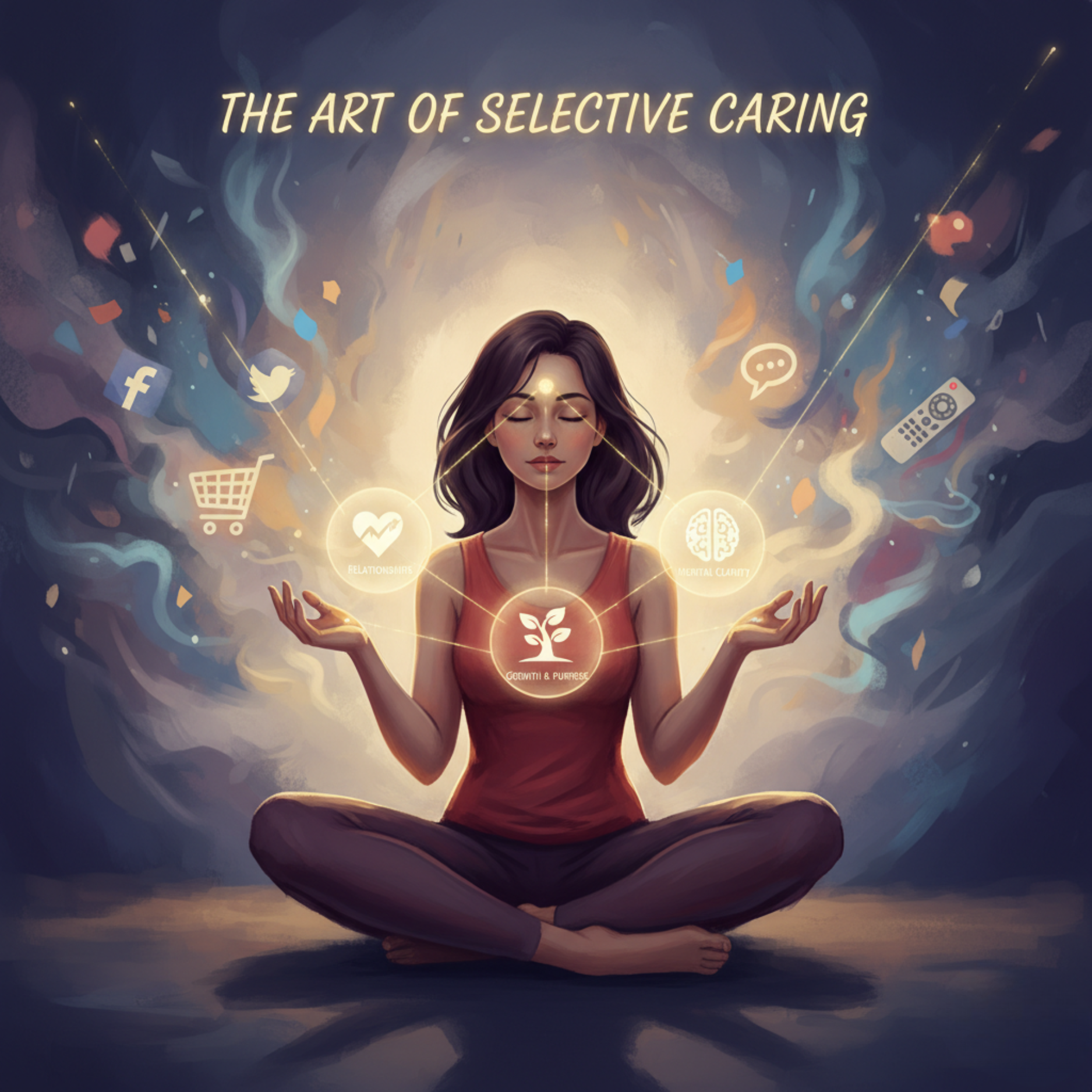
This article is about mastering the Art of Selective Caring—a core principle of Self-Mastery. It’s about consciously choosing when to engage your energy and when to embrace a healthy sense of nonchalance. By practicing this art, you don’t become a cold or indifferent person; you become an incredibly powerful, focused, and empowered one.
Part I: The Cost of Indiscriminate Caring
Before we learn how to select, we must understand the severe cost of caring about everything.
1. The Energy Drain: The Paradox of Over-Commitment
Every small worry, every minor criticism, and every irrelevant piece of gossip you choose to internalize consumes a measurable amount of mental energy. This constant consumption leads to Decision Fatigue and Emotional Exhaustion.
- Decision Fatigue: When your brain is overloaded with trivial concerns (e.g., caring too much about what strangers on social media think, worrying about a colleague’s passive-aggressive email), your capacity to make important decisions (e.g., career moves, financial planning) diminishes. You exhaust your cognitive bandwidth on matters that don’t deserve it.
- Diluted Focus: Imagine a powerful laser beam. If you spread that beam across a wide area, its power is negligible. If you focus it on a single point, it can cut through steel. Your care is that laser beam. When you care selectively, you can achieve remarkable things. When you care about everything, you achieve nothing with excellence.
2. The Trap of External Validation
Indiscriminate caring often stems from a deep-seated need for external validation. We worry about every single opinion because our sense of self-worth is tied to the approval of others.
- The Approval Loop: You care what your boss thinks, what your neighbour thinks, what your estranged aunt thinks, and what the anonymous commenter online thinks. This creates an exhausting “Approval Loop” where you are constantly tweaking your behaviour, opinions, and even appearance to fit external standards.
- The Loss of Identity: The more you care about conforming to what others expect, the further you drift from your true, authentic self. This erosion of identity is the highest cost of non-selective caring.
Part II: The Three Filters of Selective Caring
Selective Caring is not about not caring; it’s about applying intentional filters to your energy investment. Use these three filters to determine where your valuable care should be placed.
Filter 1: The Circle of Control Test
This is the most critical filter. You should only invest significant emotional energy into things that fall within your Circle of Control.
- In your Circle of Control: Your effort, your attitude, your response to a situation, your boundaries, your personal development, and your daily actions. Invest heavily here.
- Outside your Circle of Control: Other people’s opinions, past mistakes, traffic jams, global economic policies, the weather, and someone else’s mood. Practice radical nonchalance here.
The moment you start worrying about something outside your control, you are wasting energy that could be spent improving something you can control. Stop trying to steer ships you are not captain of.
Filter 2: The Core Values Alignment Test
Every well-balanced individual has a set of Core Values (e.g., Integrity, Family, Health, Freedom, Growth). Your time, energy, and care should align with these values.
Ask yourself: “Does caring about this situation/person/issue move me closer to my core values or further away?”
If your core value is Health, caring about the latest celebrity scandal is a distraction. If your core value is Integrity, caring about justifying a minor white lie is a necessary investment.
Selective Caring means ruthlessly abandoning concerns that are irrelevant to your personal mission and deeply held values.
Filter 3: The Long-Term Impact Test
Often, our minds inflate minor inconveniences into major crises. The Long-Term Impact Test forces you to see the situation with perspective.
Ask yourself: “Will this matter a month from now? A year from now? Five years from now?”
- A rude waiter? (No)
- A major disagreement with your life partner? (Yes)
- Missing a small deadline? (Probably no)
- Neglecting your physical health for three months? (Absolutely yes)
If the answer is no, treat the concern with nonchalance. If the answer is yes, then it deserves your focused, strategic care.
Part III: The Empowerment Gained from Letting Go
When you successfully apply the three filters and eliminate indiscriminate caring, the immediate result is a massive influx of personal empowerment.
1. Reclaiming Your Time and Focus
By deciding what not to care about, you instantly create space. That space is not empty; it is immediately filled with available energy. This energy can be directed toward creative pursuits, deep work, meaningful relationships, or simply self-care.
Example: Stop caring about keeping up with everyone on social media. Suddenly, you have 30 minutes every day to dedicate to learning a new skill or meditating. That is empowerment in action.
2. Developing Inner Firmness
Selective Caring forces you to rely on an internal locus of control. Since you no longer seek validation from every external source, your sense of self-worth becomes stable and unwavering.
As your book emphasizes, a well-balanced individual knows when to be firm and when to show compassion. When you stop caring about trivial opinions, you gain the firmness to protect your boundaries, say ‘no’ to time-wasters, and stand by your convictions—even when they are unpopular. This is true Self-Mastery.
3. Deepening True Connection
Ironically, caring less about everything allows you to care more deeply about the few things that genuinely matter.
- You stop spreading thin your emotional resources among superficial acquaintances.
- You focus your attention on your closest relationships, giving them your full, undistracted presence and genuine empathy.
- Your compassion, when offered, is authentic and impactful, not just a strained response out of obligation.
Selective Caring elevates the quality of every single human connection you choose to keep.
Part IV: Practical Strategies for Nonchalance
How do you practically implement “nonchalance” in daily life?
A. The Two-Minute Rule for External Problems
If you encounter an external problem (e.g., a glitch, a small mess, a confusing email):
- Can I fix or influence this in under two minutes? (Yes: Fix it and move on. No: Proceed to step 2.)
- Does this fall outside my Circle of Control? (Yes: Mentally “tag” the problem as NOT MY BUSINESS and immediately shift your focus to your current task.)
This rule prevents minor issues from derailing your entire day.
B. Muting the Digital Noise
The digital world is a graveyard of wasted care. You need to actively filter the noise.
- Unfollow/Mute: Ruthlessly eliminate any social media account, news source, or mailing list that consistently makes you feel angry, anxious, or inadequate, but offers no functional value.
- Scheduled Consumption: Never consume news or social media passively. Set aside 15 minutes a day for it, and then close the apps. Treat information consumption as a task, not an addiction.
C. The Power of “I Choose Not To Care”
When a worry or concern surfaces that you’ve already determined fails the Three Filters, silently state to yourself: “I see this thought, and I choose not to invest my energy here.”
This simple declaration is an act of Self-Mastery. It reclaims your psychological space and reinforces your commitment to only caring about high-value issues.
Conclusion: The Path to Balanced Empowerment
The Art of Selective Caring is the foundation of a balanced and empowered life. It is the wisdom to know the difference between matters that demand your fierce attention and those that deserve your complete, peaceful neglect.
By intentionally pulling back your emotional investment from the chaos and noise of the world, you are not retreating; you are consolidating your power. You are reclaiming the physical, mental, emotional, and spiritual energy necessary to live a life aligned with your truest higher self.
Stop draining your resources on what doesn’t move your life forward. Start investing your care only where it can create profound, lasting change. Your fulfilled and balanced life depends on it.
This principle of discernment—knowing when to stand firm and when to embrace a sense of nonchalance—is fully explored in Daniel Rosado’s guide to Self-Mastery and Empowerment.